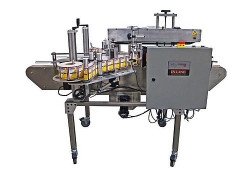
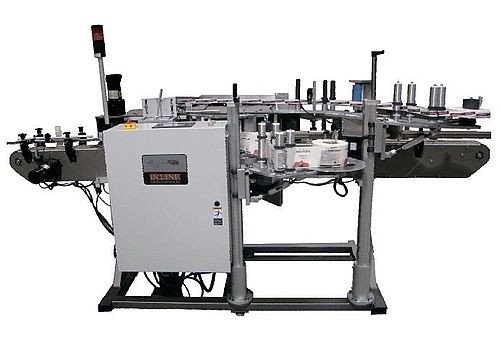
The Paradigm 700NR Labeler is a variable speed, fully automatic labeling machine. It can apply labels to non-round containers and with the addition of a wrap station can label round containers as well. It will apply two labels (front and back) since two labeling heads are utilized. The machine utilizes all stainless steel and aluminum construction and off-the-shelf components rather than proprietary boards and motors.
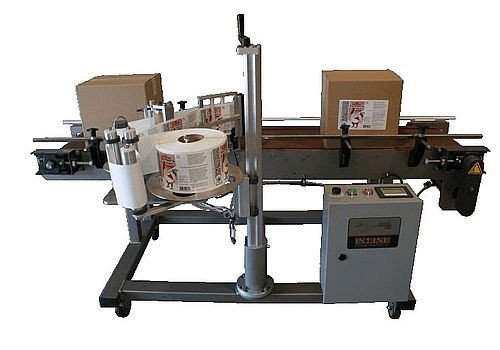
The model 680 Pressure Sensitive Case Labeler is a fully automatic labeler especially designed for ease of operation. It comes with a self-teaching label gap sensor that makes set up uncomplicated and trouble-free. The machine has a high rate of consistency with a fixed conveyor speed of 680 ipm. It is designed for accurate placement of labels on cases and boxes. Standard features on the 680 Case Labeler are a self-teaching label gap sensor, a microprocessor control, and stepper-driven labeling applicator.
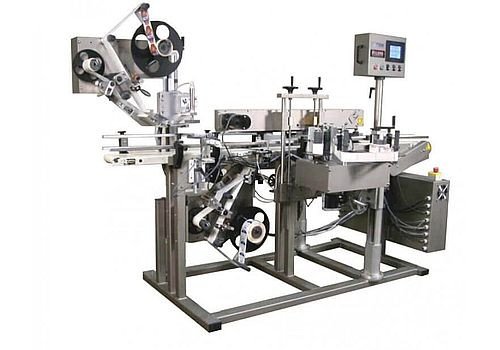
The Paradigm 700 is a fully automatic label applicator capable of applying labels to a variety of products. Label application can be from the top down, bottom-up, or both.
Incoming round containers are spaced using a single powered feed screw. Non-round containers require dual feed screws. The conveyor is driven by a variable speed motor.
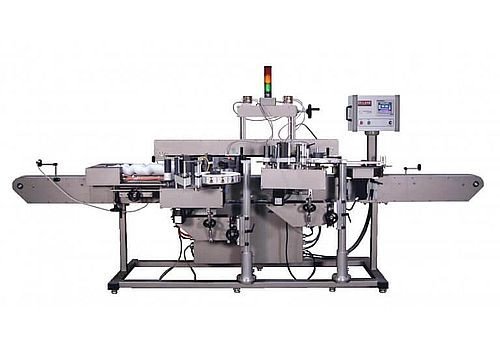
The Model 2000NR is designed to apply front and back labels to non-round and round bottles at speeds up to 300 bpm. By adding a third labeling station and a Wrap Station Assembly, the 2000NR can apply neck wrap labels to round bottles
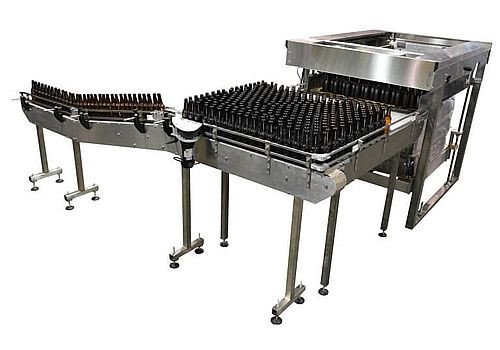
Half-stack pallets are placed into the depalletizer frame using a forklift or pallet jack. Once inside the frame, the operator will cut and remove the shrink wrap, exposing the top layer of bottles. An operator interface will allow the user to start the process, and the pallet will be raised to the correct level so that the base of the top layer is level with the feed table. A motorized pusher bar will engage and push bottles out onto the feed table, starting and stopping as bottles are needed. Bottles will transfer out onto the feed table, and from there be fed onto the right-angle conveyor. The table, conveyor and pusher belt turn on and off automatically based on a downstream photoeye indicating the need for bottles. If the line is full the system waits until bottles are needed and then restarts.